

In the wake of COVID-19 this spring, building websites across the nation cleared out along with neighboring restaurants, retailers, offices and other commercial facilities. Debates ensued over whether the building and construction market’s seven million staff members should be considered “vital,” while guidelines continued to shift on the operation of task websites. Project need progressively shrank.
In the middle of the chaos, building and construction firms faced an existential concern: How will they make it through? This concern is as pertinent today as it remained in April. As one of the least-digitized sectors of our economy, building is ripe for technology disruption.
Building is a huge, $1.3 trillion market in the United States– an intricate environment of loan providers, owners, developers, designers, general professionals, subcontractors and more. While each building job has a mix of these essential roles, the building and construction procedure itself is highly variable depending upon the asset type. Roughly 41% of domestic building and construction worth is in house, 25% in business property and 34% in commercial tasks. Due to the fact that each possession type, and even subassets within these classes, tends to include a various set of stakeholders and processes, many building and construction companies concentrate on one or a few asset groups.
Regardless of asset type, there are 4 crucial difficulties throughout building and construction jobs:
High fragmentation: Beyond the designer, architect, engineer and general contractor, projects might involve hundreds of subcontractors with specialized expertise. As the scope of the project increases, coordination amongst parties becomes decision-making and increasingly difficult slows.
Poor interaction: With a lot of various celebrations both in the field and in the office, it is often hard to relay info from one party to the next. Miscommunication and bad project information represent 48% of all remodel on U.S. construction job websites, costing the market over $31 billion yearly according to FMI research.
Absence of information transparency: Handbook information collection and information entry are still typical on building and construction sites. On top of being error-prone and tiresome, the lack of real-time data is exceptionally minimal, for that reason decision-making is frequently based on out-of-date info.
Experienced labor lack: The construction labor force is aging quicker than the more youthful population that joins it, leading to a scarcity of labor especially for knowledgeable trades that may require years of training and certifications. The lack drives up labor expenses across the market, particularly in the domestic sector, which generally sees higher attrition due to its more variable job demand.
A building tech boom
Too many of the key procedures involved in managing multimillion-dollar building and construction tasks are carried out on Excel and even with pen and paper. The lack of tech sophistication on building websites materially contributes to job delays, missed budget plans and increased task site security threat. Technology startups are emerging to assist fix these issues.
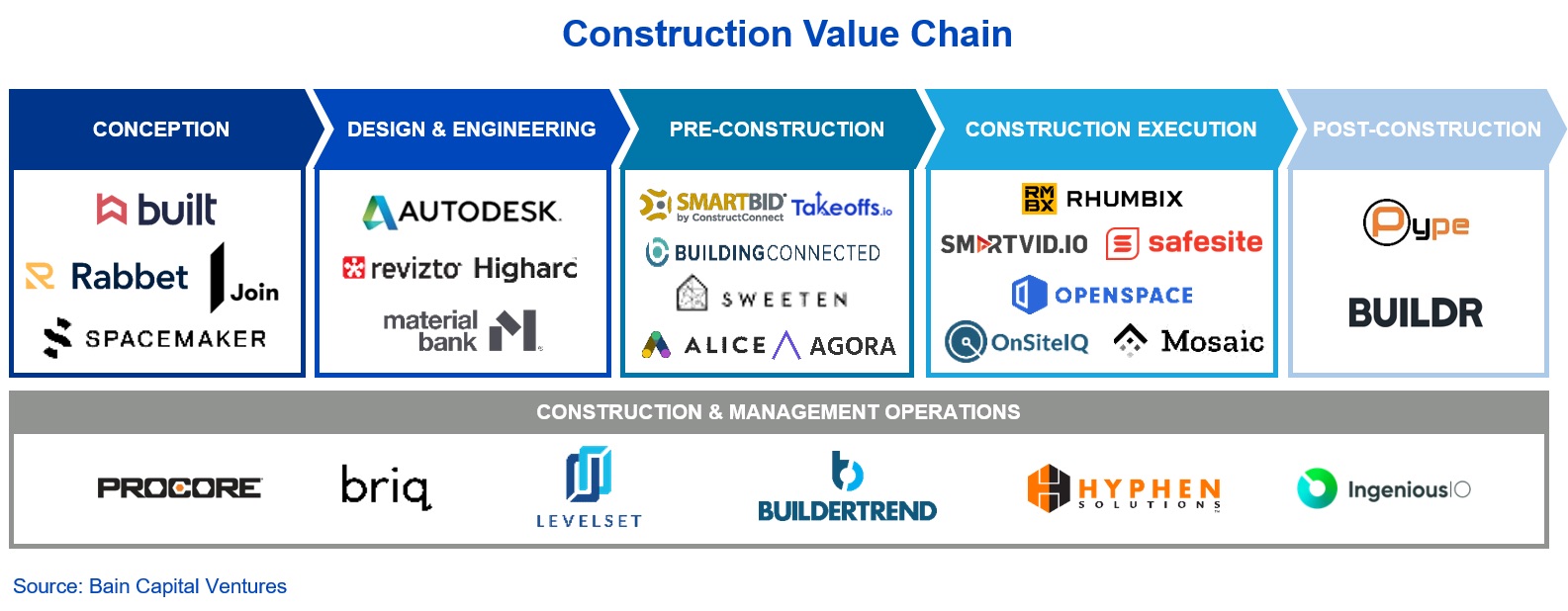
Image Credits: Bain Capital Ventures(opens in a brand-new window)(opens in a new window)
Here are the primary categories in which we’re seeing construction tech start-ups emerge. 1. Task conception How it works today: During a job’s conception, asset owners and/or developers establish
siloed from the specialists
- , it’s difficult for engineers and designers to know the real-time impact of their decisions on the supreme cost or timing of the project.
- Lack of coordination with construction teams can result in lengthy modifications. How technology can address obstacles: Of all the elements of the building and construction procedure, the style and engineering process itself is the most highly advanced today, with reasonably high adoption of software like Autodesk to help with style paperwork
- , specification development, quality control and more. Autodesk is moving downstream to provide a suite of services that consists of construction management, offering more connectivity between the teams. Article curated by RJ Shara from Source. RJ Shara is a Bay Area Radio Host (Radio Jockey) who talks about the startup ecosystem – entrepreneurs, investments, policies and more on her show The Silicon Dreams. The show streams on Radio Zindagi 1170AM on Mondays from 3.30 PM to 4 PM.
- , specification development, quality control and more. Autodesk is moving downstream to provide a suite of services that consists of construction management, offering more connectivity between the teams. Article curated by RJ Shara from Source. RJ Shara is a Bay Area Radio Host (Radio Jockey) who talks about the startup ecosystem – entrepreneurs, investments, policies and more on her show The Silicon Dreams. The show streams on Radio Zindagi 1170AM on Mondays from 3.30 PM to 4 PM.
Recent Comments